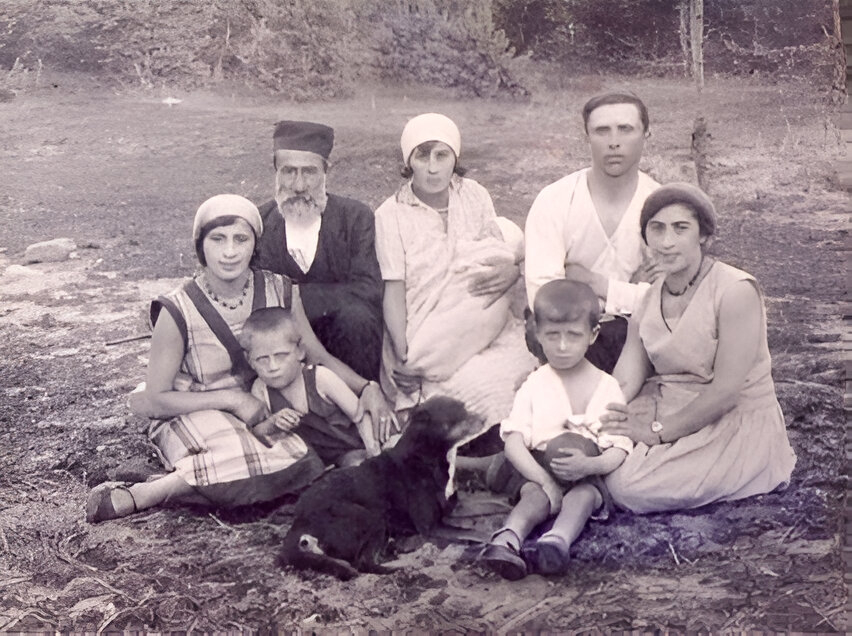
Back row, from left: Sister-in-law of Max Farber; Mordechai Farber (father of Max); sister-in-law of Max Farber holding her child; Max Farber; and Zisel Farber (first wife of Max).
Front Row, from left: Isaac Farber and David Farber (sons of Max and Zisel Farber).
Name of Exhibit: Family of Max Farber
Submitted by: Anonymous
Date of Origin: c. 1936
Origin of Object: Outside of Boćki, Poland
Description: Photo of Max Farber and his family in Poland on the outskirts of the village Boćki in north-eastern Poland. Pictured in this photo are his first wife, Zisel Farber; his father, Mordechai Farber; his two children: Isaac and David Farber; his two sisters-in-law; and his infant nephew. Everyone in this photo, as well as the Jewish inhabitants of Boćki, including Max’s mother, grandparents, siblings and their families, perished in Treblinka. Max was the sole survivor of the Boćki ghetto.
Voyage to Ottawa: After the war, Max made his way to a Displaced Person’s Camp and left Europe in 1948. He started a new life in Ottawa, Canada, with his second wife Gertrude Farber (née Coopersmith) and had two sons, Bernie and Stanley. Max Farber brought the photograph with him when he emigrated to Canada.
Before the war, Boćki had an estimated 600-700 Jews living in the village. In March 1942, German Gendarmes, assisted by the SS, occupied the village and forced its Jews to relocate to two small ghettos to be enslaved into forced labour. Then on November 2nd, 1942, the Boćki ghettos were liquidated by the SS, the local Gendarmerie, and the local Polish Schutzmänner. The ghettos’ inhabitants were relocated to join the other 11,000 Jews sequestered in the Bielsk Podlaski ghetto. For the next two weeks, the Nazis began deporting at least 1,000 Jews daily from that ghetto to the Nazi death camp, Treblinka. All the Jews deported to Treblinka were immediately gassed upon arrival.
The same night of the ghetto’s liquidation, Max secretly escaped over the ghetto fence to scrounge for food to bring back to his family. Upon his return, he found the ghetto empty and his family gone, only to learn later that they were all sent to Treblinka.
Max ran from the ghetto and was provided shelter to hide from the Nazis in the underground dugout of a barn owned by his Christian friend, Julian. He eventually left his hiding place when Julian’s wife discovered him. Max later fought with the Jewish resistance movement in Poland until the end of the war.